
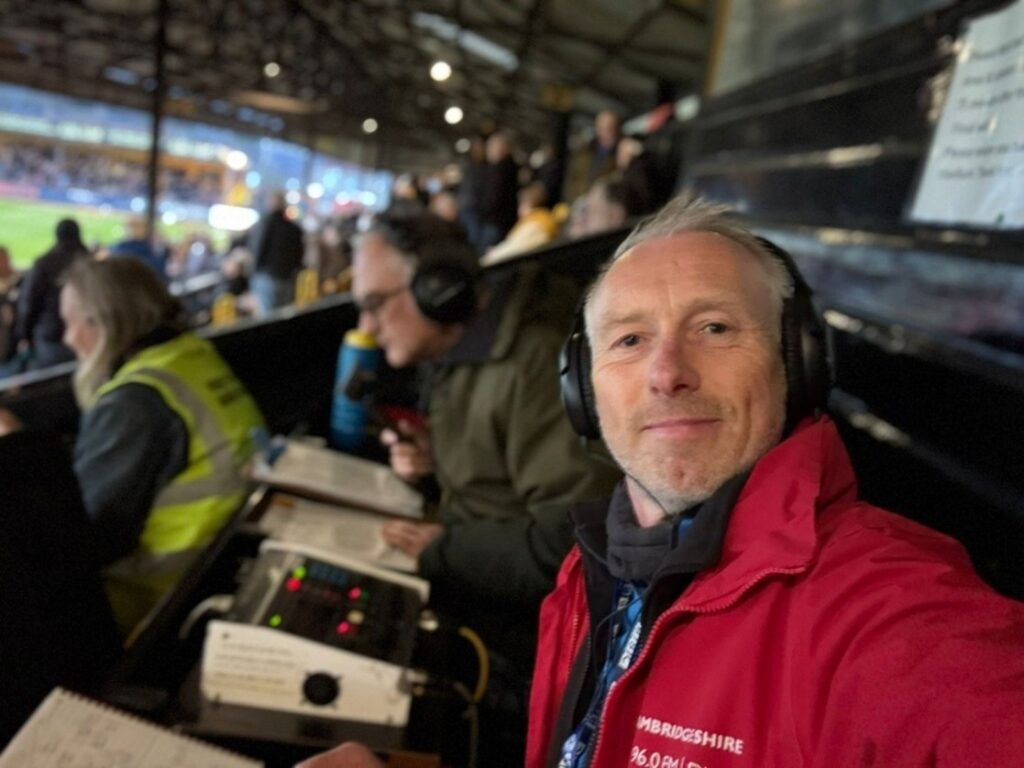
BBC Radio Cambridgeshire’s Doug Shulman explains the pre-match preparation process, delivering manager/player interviews and life in the commentary box.
This interview was conducted by Jamie Mann, a student journalist at UEA, Norwich who has kindly given permission for CFU to reproduce the interview.
| Doug has followed the U’s since 1980 (Photo Credit: Doug Shulman) |
Commentary pair Doug Shulman and Mark (‘Johnno’) Johnson are household names for Cambridge United fans. For years, they have delivered hundreds of matches across the airwaves to our living rooms, kitchens and cars; a reassuring constant alongside the emotional roller-coaster of following the U’s.
A United supporter since 1980, Doug caught the bug after a 10-0 pre-season victory over Haverhill Rovers; visiting the Abbey Stadium more and more regularly over the decade.
“Early 90s, I stood behind the goal as everyone else does, and also standing behind the goal was Mark Johnson. I kind of struck up a conversation with him one day and we seemed to get on pretty well and before we knew it there was a group of us travelling to away games together. Then he scored a job at United and asked if I wanted to write for the matchday programme.”
Doug went on to write for the programme for the next 32 years, up until the end of the 24/25 season. His first taste of radio summarising came in 2007, when Mark (who had taken the role of BBC commentator), asked if he was available the following day.
“I was in the pub on a Friday night and he called me saying he needed a summariser for tomorrow and if I was free. It was Halifax away and I said: ‘I’ve never done anything like this.’ He said I’ll pick you up in the morning and we’ll have a chat on the way. I haven’t looked back since really.”
At this time, long-serving voice Steve Line was the regular summariser.
“Steve’s job and responsibilities kept him busier and busier all the time, so he was having to do less summarising. I ended up standing in for him for 15 or so games a season. In 2012, I got a call saying ‘Steve can’t do it anymore, do you want the gig on a full-time basis?’”
So, how have Doug and Johnno built an on-air chemistry?
“Sitting behind a microphone is very reactionary all the time and you have to get the line right in terms of when Mark speaks and when I speak. What obviously helps hugely is the fact that we knew each other very well before I started. You just kind of build up a bit of a rapport and it just becomes instinctive after a short while. I know when he needs to speak and he knows when I need to speak. Sometimes I cut in, sometimes he’ll cut in. I have to be very short, sweet and brief in my assessment of what’s going on. As soon as something looks like it’s going to happen, or Mark cuts across me, I just stop speaking. It’s just an instinct. Once the game starts, you forget you’re holding a microphone. It’s just like having a chat with a mate; you don’t speak over each other. It takes a little while to get know what to say, how to say it and for how long.”
Today’s game is ever more data-driven and Doug’s collection of key numbers and observations are an important part of the listener experience. He spends around an hour a day preparing for upcoming fixtures.
“I have pages of player statistics and various levels of information that could be useful throughout the game. For instance, Liam Bennett is on 150 games, Michael Morrison’s got his 250th coming up. You’ll only refer to around 5% of your preparation, but you don’t know what’s going to emerge in a particular game scenario.”
“I update all the U’s stats straight after a game. I update each player, if they scored; any bookings; Neil Harris’ stats in terms of his time at the club; attendances, assists, head/foot goals, set-pieces, open play. That starts my prep for an upcoming game. I’ll look, for example, at Notts County, what their current form’s like, away form, the head-to-head record, and any other interesting stats. It’s almost like a comfort blanket to refer to if you need it.”
The BBC’s post-match interviews are also conducted by Doug, in frequent conversation with the United coaches and players at press-conferences and matches. He explains that it’s important to build up those good relationships.
“I make a point to get to know all the managers a little bit. You’re basically gaining their trust and vice versa. I go to a press conference on a Thursday, and I’ll often chat to a manager more before the formal press conference, or after. In fact, Neil jokingly said to me a couple of weeks ago that ‘I think I talk to you more than my wife!’ It’s down to building that relationship and with any working relationship comes trust. Then you know how far you can go with an interview. Essentially, it’s about getting good content for our listeners. Neil’s a star really, because not only will he give you an answer, he’ll expand on it. In the build-up to a game, I’ll listen to my previous interview two or three times and the pre-match conference. Off the back of that, you’ll pick-up on certain things that he’s said, or content that you think could be used in an interview to refer to. You have to ask challenging questions, but at the same time he doesn’t like stupid questions or those that state the obvious!”
“We’re in a very fortunate position at United to have had a really good run of managers that are easy to work with and respectful. Gary Monk was really chatty and a lovely fella, Joe Dunn as well, and Mark Bonner was an absolute dream to interview due to his articulate and open manner.”
“When Neil was re-appointed, he and I had a quick conversation, just over messages. I made sure that we had that brief exchange, so we weren’t going in completely cold. Neil’s really easy to work with.”
Doug sees local radio as a staple for connecting people with their community and says that the need for the service is just as important now as it ever was.
“Like any organisation, at the BBC we’re always under pressure to perform. Sport is a huge part of any local radio station; it’s always the flagship programme. We have to do it under some constraint at times, but it’s really important. There’s a lot of people out there that love local radio and they may never have been to a game of football before. I’ve spoken to people who’ve never been to the Abbey stadium, but they like tuning into a game on a Saturday afternoon. My day job is in Agricultural Consultancy, and I spoke to a chap the other day who said ‘when I’m out on my tractor on a Saturday afternoon, I stick the radio on and listen to you when I’m driving around.’ People like that connection with the local community and that locality. That sums up how important local radio is. It can be a real life-line for a lot of people. It’s a privilege to deliver what we do.”
“Over lockdown, Johnno and I were very fortunate to cover games all over the country in empty stadiums. It was the most bizarre season you could imagine, especially because United were promoted in that year. We were really fortunate. We didn’t really think of it at the time, but we had a lot of people speak to us saying ‘thank you for delivering a promotion season over the airwaves’. Without local radio, that’s gone. There’s always threats in terms of restricted funding, etcetera. We do what we can to maintain that, because we feel that’s very important.”
“It helps our coverage that I am a U’s fan, as is Johnno, so you get that emotional connection. What you always have to remember is to be impartial, because you get opposition that will come to the Abbey and their local radio doesn’t cover their club. Very often, you’ll get those opposition fans listening to BBC Radio Cambridgeshire. You have to be very careful that you’re balanced, not too biased towards one particular side. That takes a little while to adapt to, but what I always think is that the last thing opposition fans want to listen to is us waxing lyrical about United and not giving the opposition any credit or pre-prepared detail on their players. I have listened to a few stations from elsewhere and you think they haven’t done their homework, and they talk about ‘we’, rather than ‘they’; and I think that’s really key. It’s all about balance and pitching it in the right way.”
Across the many games that Doug has covered, what are his favourite memories of summarising for Cambridge United?
“We’ve had some incredible days out. The first one I did, Halifax, was pretty special. I came away thinking, crikey, that’s something to stick on the CV. Every time you’re drawn with a Premier League club in the cup and you get that big visit, win lose or draw. Manchester United away at the FA cup was a great experience. The U’s lost the game, but it’s not very often that you can say ‘I did a commentary at Old Trafford last night.’ Newcastle away was very special for me. I’ve got a lot of family in the north-east; my wife’s from there and a huge Newcastle fan, so that was a very personal time for me. It was an impossibly good day, in lots of ways. A really historic moment.”
“The best day out, which will never be beaten I don’t think, is 18th May 2014, when United got themselves back into the Football League after beating Gateshead 2-1 at Wembley. That was something else. I’ve listened back to the show a couple of times. We were right there amongst it.”